System Architecture
Cursus turns a pipeline graph plus a set of step configurations into a
production-ready SageMaker pipeline. This page is the map: it names the
layered subsystems, shows how a request flows from a DAG to a compiled
sagemaker.workflow.pipeline.Pipeline, and points to the deeper concept pages
for each layer.
If you only remember one sentence: a DAG names the steps and their edges, the configs supply the parameters, and the compiler + assembler + dependency resolver wire them into a real SageMaker pipeline — everything else (the step library, the catalog, the registry, validation, MCP, CLI) exists to make that one transformation discoverable, correct, and automatable.
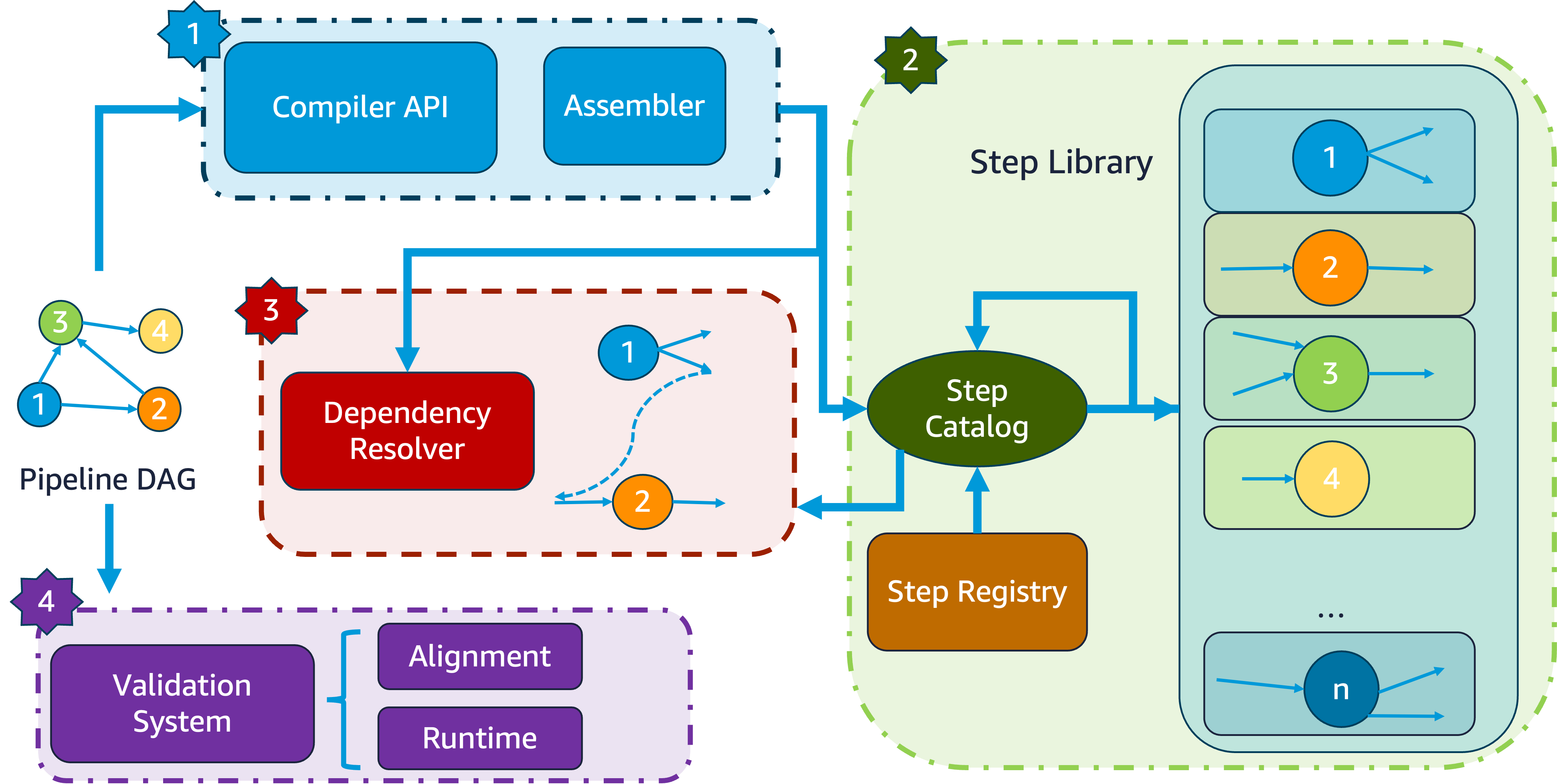
The Cursus subsystems. A Pipeline DAG enters the Compiler API + Assembler (1); the Step Catalog and Step Registry resolve each node to a step from the Step Library (2); the Dependency Resolver (3) wires producer outputs to consumer inputs; and the Validation System (4) checks alignment and runtime behavior.
The 10,000-foot view
                        YOU AUTHOR
        ┌────────────────────────┐        ┌───────────────────────────┐
        │  PipelineDAG            │        │  config.json / .yaml      │
        │  nodes + edges          │        │  one config per DAG node  │
        │  (api/dag)              │        │  (steps/configs)          │
        └───────────┬────────────┘        └─────────────┬─────────────┘
                    │                                    │
                    └──────────────┬─────────────────────┘
                                   ▼
              ┌──────────────────────────────────────────────┐
              │  PipelineDAGCompiler        (core/compiler)   │
              │   • build a DynamicPipelineTemplate           │
              │   • detect required config classes            │
              └───────────────────────┬──────────────────────┘
                                      ▼
              ┌──────────────────────────────────────────────┐
              │  DynamicPipelineTemplate    (core/compiler)   │
              │   • node  -> config     (StepConfigResolver)  │
              │   • node  -> builder    (StepCatalog)         │
              └───────────────────────┬──────────────────────┘
                                      ▼
              ┌──────────────────────────────────────────────┐
              │  StepCatalog / registry  (step_catalog +      │
              │  registry)                                    │
              │   • load_builder_class("XGBoostTraining")     │
              │   • builder SYNTHESIZED at runtime from the   │
              │     step's .step.yaml  (no builder_*.py)      │
              └───────────────────────┬──────────────────────┘
                                      ▼
              ┌──────────────────────────────────────────────┐
              │  PipelineAssembler          (core/assembler)  │
              │   • builder.create_step(**kwargs) per node    │
              │   • wire edges via dependency resolution      │
              └───────────────────────┬──────────────────────┘
                                      │ uses
                                      ▼
              ┌──────────────────────────────────────────────┐
              │  UnifiedDependencyResolver  (core/deps)       │
              │   • match one step's outputs to the next      │
              │     step's declared inputs (semantic match)   │
              │   • emit PropertyReference wiring             │
              └───────────────────────┬──────────────────────┘
                                      ▼
                        ┌──────────────────────────┐
                        │  sagemaker ...Pipeline    │
                        │  pipeline.definition()    │
                        │  pipeline.start()         │
                        └──────────────────────────┘

  CROSS-CUTTING (used at every stage, not in the linear flow):
   • steps/interfaces  — the .step.yaml contract+spec for each step type
   • pipeline_catalog  — pre-built DAGs you can load instead of hand-building
   • validation        — proves scripts/interfaces/wiring line up (alignment)
   • mcp               — the same engine exposed as JSON tools for LLM agents
   • cli               — the same engine exposed as `cursus` subcommands
Subsystem responsibilities
Subsystem |
Responsibility |
Package path |
|---|---|---|
DAG / graph model |
The topology data structure: nodes, edges, topological sort, JSON (de)serialization. |
|
Compiler |
Entry point. Wraps a DAG + config into a |
|
Assembler |
Instantiates each step builder, calls |
|
Dependency resolution |
Semantic matching of one step’s declared outputs to the next step’s declared inputs; produces |
|
Base interfaces |
The shared abstractions: |
|
Step catalog |
Discovery. Given a step name, find its config class, interface, script, and (synthesized) builder across the package and any workspaces. O(1) lookups. |
|
Registry |
The canonical step-name table ( |
|
Step library |
The actual step types: one declarative |
|
Pipeline catalog |
Pre-built, reusable DAGs ( |
|
Validation |
Alignment testing — proves that a step’s script, interface, and registry binding line up, and that DAG edges are resolvable. |
|
MCP |
The whole engine exposed as framework-neutral JSON-in/JSON-out tools for LLM agents. |
|
CLI |
The whole engine exposed as |
|
The request flow, step by step
2. The compiler wraps it in a template
PipelineDAGCompiler (core/compiler/dag_compiler.py) is the top-level entry
point. The one-call convenience function is compile_dag_to_pipeline (also
exported as cursus.compile_dag):
from cursus.core.compiler import PipelineDAGCompiler

compiler = PipelineDAGCompiler(config_path="config.json")
pipeline = compiler.compile(dag, pipeline_name="fraud-detection")

# Or, to get a diagnostics report alongside the pipeline:
pipeline, report = compiler.compile_with_report(dag)
Internally the compiler builds a DynamicPipelineTemplate
(core/compiler/dynamic_template.py), a subclass of PipelineTemplateBase that
implements the template’s abstract methods dynamically — it works for any DAG
rather than being hand-written per pipeline. On construction it auto-detects the
config classes the DAG requires (_detect_config_classes).
3. The template resolves node -> config and node -> builder
For each DAG node the template answers two questions:
Which config?
StepConfigResolver(step_catalog/adapters/config_resolver.py, re-exported ascore.compiler.StepConfigResolver) matches the node name to a loaded config object from your config file.Which builder? The
StepCatalogloads the builder class:StepCatalog().load_builder_class("XGBoostTraining").
4. The catalog synthesizes the builder
This is where the 2.0.0 classless-factory design shows up. There is no
builder_xgboost_training_step.py file. Instead, for any registry step that has
a .step.yaml interface, step_catalog/builder_discovery.py synthesizes a
builder class at runtime — type(f"{Name}StepBuilder", (TemplateStepBuilder,), {"STEP_NAME": Name}) — and caches it per process. Every step builder is the
same shared TemplateStepBuilder facade (core/base/builder_templates.py)
whose construction methods (create_step, _get_inputs, _get_outputs,
_get_environment_variables) delegate to one of five PatternHandler
strategies:
Handler |
Builds |
|---|---|
|
Processing steps (both the |
|
Training steps |
|
CreateModel steps |
|
Batch Transform steps |
|
MODS/SAIS predefined steps (Cradle / Redshift / Registration / DataUploading) |
The right handler is chosen by resolve_handler(sagemaker_step_type, step_assembly, knobs) (defined in core/base/builder_templates.py), which in
turn consults the strategy table via resolve_strategy(axis, name) in
registry/strategy_registry.py. Per-step behavior that isn’t shared lives as
declarative knobs in the .step.yaml patterns: section — not as overridden
Python. There is no cursus.steps.builders module and no builder_*.py files;
the only way to obtain a builder is through the catalog
(StepCatalog().load_builder_class("XGBoostTraining")), which returns the
synthesized TemplateStepBuilder subclass.
The registry itself (STEP_NAMES and its derived maps CONFIG_STEP_REGISTRY,
BUILDER_STEP_NAMES, SPEC_STEP_TYPES) is likewise derived by construction
from the .step.yaml registry: blocks
(registry/interface_registry_loader.py::build_registry_from_interfaces) rather
than read from a standalone table — so the registry can never drift from the
interface files.
5. The assembler builds and wires the steps
PipelineAssembler (core/assembler/pipeline_assembler.py) takes the resolved
{node: builder} and {node: config} maps and, in topological order:
Instantiates each builder and calls
builder.create_step(**kwargs)to produce a real SageMaker step. The call site has noisinstancegate, so a runtime-synthesized builder is indistinguishable from a hand-written one.For each DAG edge, asks the dependency resolver how the upstream step’s outputs satisfy the downstream step’s declared inputs.
6. The dependency resolver connects the edges
UnifiedDependencyResolver (core/deps/dependency_resolver.py) does the
intelligent wiring. Each step’s .step.yaml declares its dependencies
(what it needs) and outputs (what it produces), including compatible_sources
and property_path. The resolver’s SemanticMatcher matches an upstream
OutputDecl to a downstream DependencyDecl by logical name/alias and type,
and emits a PropertyReference — the SageMaker runtime handle that carries one
step’s output into the next step’s input. RegistryManager /
SpecificationRegistry scope these specs so multiple pipelines don’t collide.
Because the wiring keys entirely on .step.yaml spec data carried on
builder.spec (plus the DAG node name) and never on a Python class, collapsing
the former per-step *StepBuilder classes into one facade leaves every edge
intact.
7. Out comes a SageMaker pipeline
The assembler returns a sagemaker.workflow.pipeline.Pipeline. You can inspect
pipeline.definition() or run pipeline.start(). The public compiler API
(PipelineDAGCompiler, compile_dag_to_pipeline, compile_with_report) is
stable across the 2.0.0 rewrite: the same DAG + the same config compiles to the
same pipeline.
The unified step interface (.step.yaml)
The keystone of the architecture is the single declarative interface per step,
introduced in 1.8.0 and completed in 2.0.0. Before 1.8.0 a step needed a
*_contract.py (script I/O) and a *_spec.py (dependency demand/supply)
and a builder_*.py. Now a step is:
steps/interfaces/xgboost_training.step.yaml   # contract + spec + registry block
steps/configs/config_xgboost_training_step.py # the typed config class
steps/scripts/xgboost_training.py             # the script (if any)
The .step.yaml is parsed into a single Pydantic StepInterface
(core/base/step_interface.py) that is a superset of the old ScriptContract
and StepSpecification. It exposes:
.contract—entry_point,expected_input_paths,expected_output_paths,expected_arguments,required_env_vars, etc..spec—step_type,node_type,dependencies,outputs, and helpers likelist_required_dependencies()/get_output_by_name_or_alias().
Contract↔spec alignment (inputs match dependency keys, outputs match output keys, paths are valid SageMaker paths) is enforced as a construction-time Pydantic invariant — a bad interface fails to load, rather than failing a separate validation tier. This one object is the message passed between the dependency resolver, the builder, and the assembler.
Cross-cutting subsystems
These aren’t stages in the linear flow; they wrap or observe it.
Validation (alignment)
validation/alignment proves the pieces line up. In the 2.0.0 boundary model,
validation checks the three things construction can’t self-verify:
B1 — script↔interface fidelity (AST analysis of the script against its
.step.yaml).B2 — cross-step DAG resolvability (every edge’s inputs are satisfiable, including the SageMaker property-path check).
B3 — registry↔handler↔config binding (
validation/alignment/validators/registry_binding_validator.py): the handler resolves, the builder loads/synthesizes, and the config covers the fields the handler reads. If B3 passes, the step is constructible.
Run it via cursus alignment — the Unified Alignment Tester (see the
CLI). (cursus validate covers the complementary local
script-testing and author-time .step.yaml checks.)
Pipeline catalog
pipeline_catalog is a queryable store of pre-built DAGs (shared_dags/*.dag.json,
indexed by catalog_index.json) plus:
router.py—recommend_dag/auto_select_dagscoring over the index,core/builders.py—build_and_compile(SAIS) andbuild_mods_pipeline(generates a MODS template class on demand),load_shared_dag/search_dags— load or search by feature/framework.
So instead of hand-building a DAG you can load_shared_dag(...) and pass it
straight to the compiler. See the
pipeline catalog reference.
MCP (agent surface)
cursus.mcp exposes the engine as JSON-in / JSON-out tools grouped into
namespaces (catalog, dag, config, compile, validate, execdoc,
pipeline_catalog, steps, strategies, plus author, project, and a
tools meta-namespace for tool introspection). It is framework-neutral: the same
ToolDef registry (mcp/registry.py, a name -> ToolDef dict) drives an MCP
server (mcp/server.py), OpenAI function-calling, and Claude tool use.
from cursus.mcp import get_registry, call_tool

result = call_tool("catalog.search", {"query": "xgboost"})
result.ok    # True / False
result.data  # JSON-serializable payload
Each call returns a ToolResult envelope (mcp/envelope.py) with .ok,
.data, .error, .remedy, and .next_steps fields. Argument schemas are
validated per tool — for example catalog.list_steps accepts only
workspace_id / job_type filters, while catalog.search requires a query.
Because a step is now one .step.yaml + one config (no builder file), an agent
can author a step and configure a pipeline entirely by tool-calling. The optional
stdio server (pip install "cursus[mcp]", then cursus-mcp) is read-only by
default — state-changing tools are opt-in via env vars — and exposes host-legal
tool names (dots become __) with per-tool safety annotations. See
the agent (MCP) tool surface and the
MCP tools reference.
CLI
cursus.cli is the human counterpart to MCP — the same capabilities as cursus
subcommands (compile, dag, config, validate, alignment, exec-doc,
pipeline-catalog, projects, catalog, registry, steps, strategies,
mcp). See the CLI reference.
How the layers depend on each other
   cli ─┐                      ┌─ mcp
        └──────────┬───────────┘
                   ▼
        core/compiler  ──▶  core/assembler  ──▶  core/deps
                   │                 │                 │
                   ▼                 ▼                 ▼
             step_catalog ◀───▶  registry  ◀───▶  core/base
                   │                 │                 │
                   ▼                 ▼                 ▼
       steps/{interfaces, configs, scripts}   +   pipeline_catalog
                                     ▲
                                     │
                              validation (alignment)
core/baseis the foundation everyone imports (StepInterface,StepBuilderBase,BasePipelineConfig, theTemplateStepBuilderfacade, enums). It depends on nothing else in this list.step_catalog+registryare the discovery/derivation layer: they read thesteps/interfaces/*.step.yamlfiles and expose lookups.core/compiler,core/assembler,core/depsare the runtime engine.cliandmcpare two thin surfaces over that engine;pipeline_catalogfeeds it pre-built DAGs;validationobserves it.
Where to go next
DAG and compilation — the graph model and the compile flow in depth.
API reference — the classes and functions named here.
Step catalog — the full list of step types.
Pipeline catalog — the pre-built DAGs.
MCP tools — the agent tool surface.
CLI — the
cursuscommand groups.